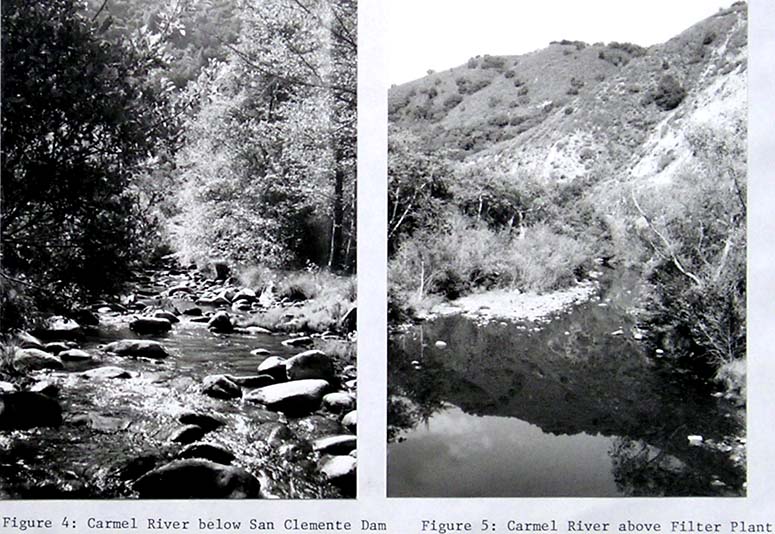
| In spring 1987, I was hired to do a bird survey of the Carmel River, Monterey County, from San Clemente Dam & Reservoir to the mouth. This 18.5 mile stretch was walked 3 times during May. I prepared a report for the Monterey Peninsula Water Management District, and the survey was incorporated into the Monterey Breeding Bird Atlas project (Roberson & Tenney 1993). Here (below) are a couple of photos from the report — yes, they were taken in black-and-white back then — of the Carmel River not far below San Clemente Dam. [and yes, the report was hand-typed on a typewriter; it's hard to remember those days actually existed . . .] | ||||
 |
||||
 Because
I also surveyed for 2 miles above the reservoir, I visited Cal-Am's property
5 times: May 2, 4, 5,7, and 14, 1987. Releases from the dam were comparatively
minimal at the time, making for a nice rushing stream below the dam, along
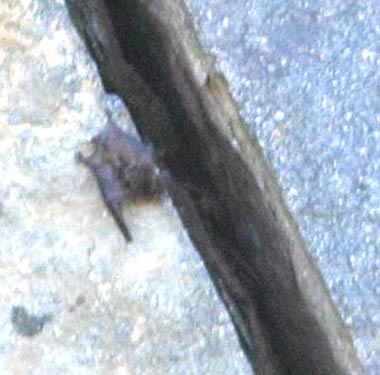
which I found and photographed a recently fledged American Dipper (left). Because
I also surveyed for 2 miles above the reservoir, I visited Cal-Am's property
5 times: May 2, 4, 5,7, and 14, 1987. Releases from the dam were comparatively
minimal at the time, making for a nice rushing stream below the dam, along
which I found and photographed a recently fledged American Dipper (left).
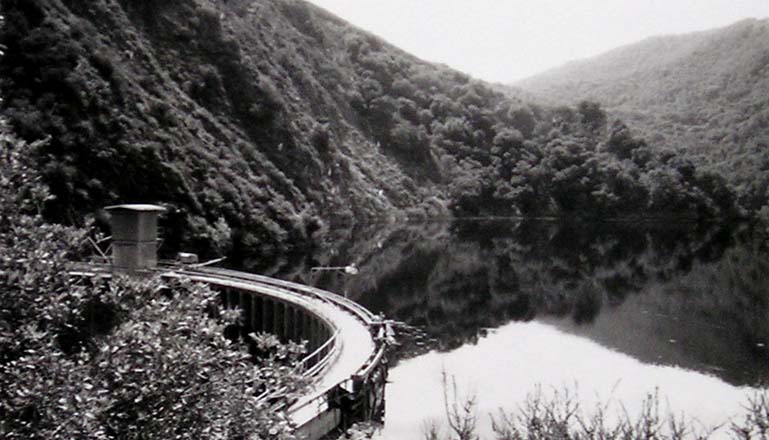
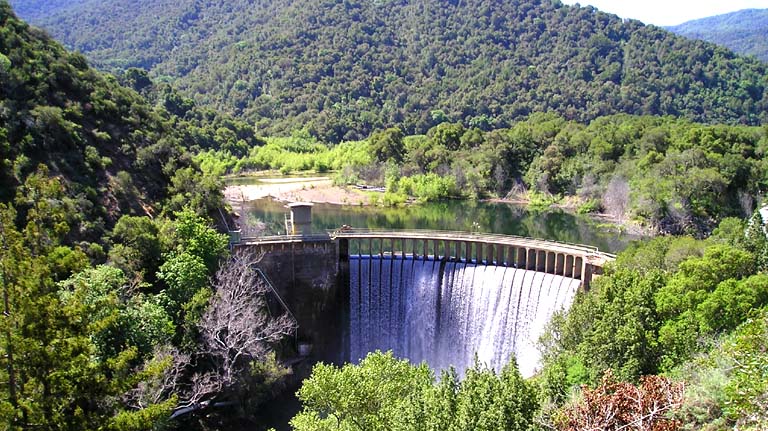
San Clemente Reservoir in May 1987 was very full (black-and-white photo below). Given this background, it was a pleasure to return to San Clemente Reservoir in May 2006, some 19 years since I las saw it. Today, the reservoir is heavily silted up (color photo below) and CalAm is keeping a heavy stream of outflow to reduce pressure on the dam. |
||||
 |
||||
 |
||||
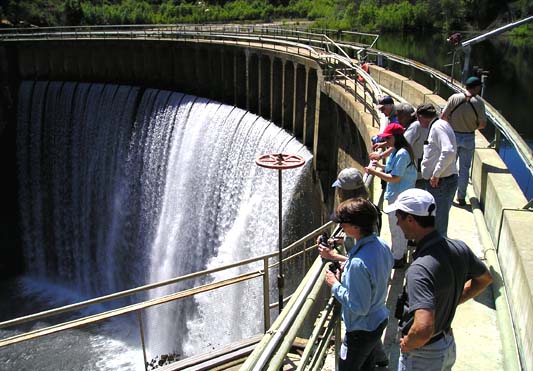 On
14 May 2006, a group of 9 local birders conducted an informal survey of
the area around the dam and downstream a couple miles. This outing was
organized by Peter Spillett of Cal-Am. We had in-hand inventories made
in December, and we supplemented the point counts in those efforts by using
the VES and AES methodology.* Remarkably, we found fledgling American Dippers
again; this time huddling just below the dam itself and visible from the
viewpoint on the dam (shown at right). On
14 May 2006, a group of 9 local birders conducted an informal survey of
the area around the dam and downstream a couple miles. This outing was
organized by Peter Spillett of Cal-Am. We had in-hand inventories made
in December, and we supplemented the point counts in those efforts by using
the VES and AES methodology.* Remarkably, we found fledgling American Dippers
again; this time huddling just below the dam itself and visible from the
viewpoint on the dam (shown at right).
We searched not only for birds, but a wide variety of wildlife and plants.
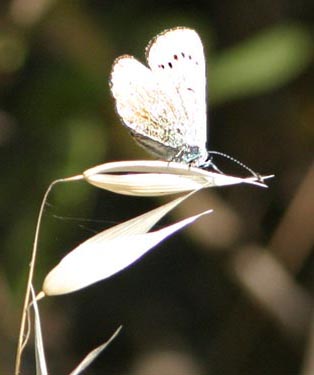
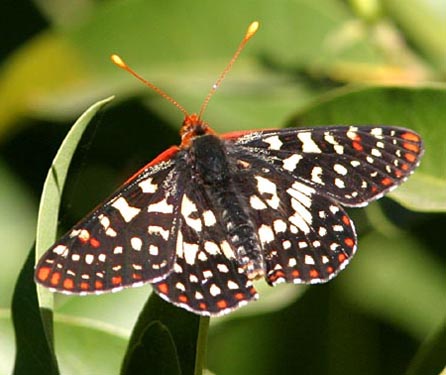
Common butterflies included Silvery Blue Glaucopsyche lygdamus (below
left) and Variable Checkerspot Euphydryas chalcedona (note the white
dots on back of the abdomen; adult life span is 9 to 10 days only!). Brian
Weed also recorded Lorquin's Admiral, W. Tiger Swallowtail, and Pale
|
||||
|
||||
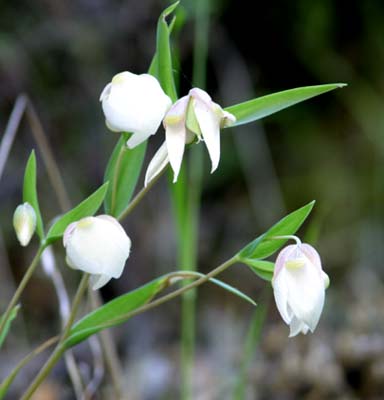 There
were a wide variety of wildflowers, but we were most interested in this
one (left), which grew in very moist spots on the shady, rocky slope. Jan
Scott has identified it as Globe-Lily (or Fairy Lantern) Calchortus
albus. There
were a wide variety of wildflowers, but we were most interested in this
one (left), which grew in very moist spots on the shady, rocky slope. Jan
Scott has identified it as Globe-Lily (or Fairy Lantern) Calchortus
albus.
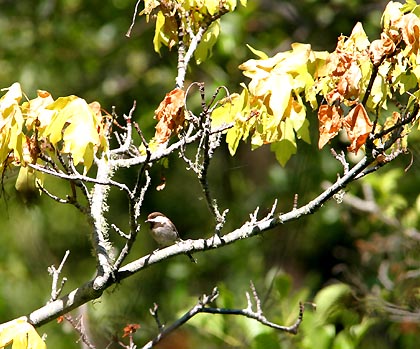
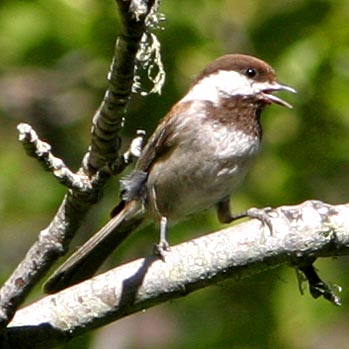
We had over 60 species of birds and much evidence of breeding. Near the upper bridge a pair of Warbling Vireo vigorously scolded a Steller's Jay that appeared to be eating an egg from their nest. Nuttall's Woodpecker, Song Sparrow, and Dark-eyed Junco were watched carrying food to be deliver to youngsters either still in, or just out of, their nests. The American Dippers were fledglings. We came upon several pair of Chestnut-backed Chickadees carrying food or with fledglings. I rather like the overall 'scene with chickadee' in a colorful sycamore (below left); this particular adult was quite agitated and vocal (below right) as it watched its mate carry food toward an unseen nest hole. I like this shot because it shows how dull the flanks can be in spring & summer in our local subspecies. |
||||
|
||||
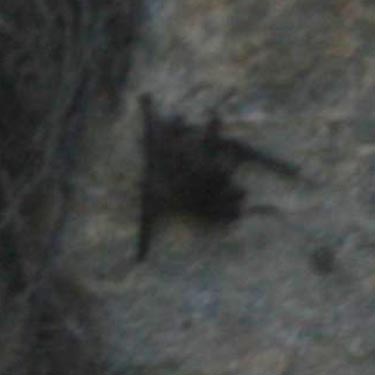
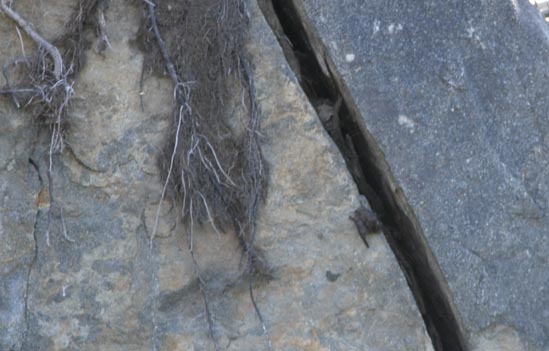 Certainly
the most unexpected moment of the morning was when a bat flushed from under
the lip of the dam and flew across a stretch of the reservoir to a vertical
cliff (left). There is scuttled down along a deep crack until it crawled
to a thinner crack and wedged itself in for the rest of the day. It appeared
to be a small bat, and I initially thought it was likely in the genus Myotis,
of which at least 7 species range to Monterey County: California Myotis
M.
californicus, Yuma Myotis M. yumanensis, Fringed Myotis
M.
thysanodes, Long-eared Myotis M. evotis, Long-legged Myotis
M.
volans, Small-footed Myotis M. ciliolabrum, and Little Brown
Bat M. lucifugus. The environmental company that did Cal-Am's formal
biological inventory used an Anabat unit to record the echolocation clicks
of bats at night over San Clemente Reservoir. The computerized analysis
of the data revealed the presence of two Myotis (Fringed & California)
over the reservoir, as well as Hoary Bat Lasiurus cinereus. Elsewhere
on the Cal-Am property, Big Brown Bat Eptesicus fuscus and Western
Red Bat Lasiurus blossevillii were detected by the recorded echolocation
clicks. Certainly
the most unexpected moment of the morning was when a bat flushed from under
the lip of the dam and flew across a stretch of the reservoir to a vertical
cliff (left). There is scuttled down along a deep crack until it crawled
to a thinner crack and wedged itself in for the rest of the day. It appeared
to be a small bat, and I initially thought it was likely in the genus Myotis,
of which at least 7 species range to Monterey County: California Myotis
M.
californicus, Yuma Myotis M. yumanensis, Fringed Myotis
M.
thysanodes, Long-eared Myotis M. evotis, Long-legged Myotis
M.
volans, Small-footed Myotis M. ciliolabrum, and Little Brown
Bat M. lucifugus. The environmental company that did Cal-Am's formal
biological inventory used an Anabat unit to record the echolocation clicks
of bats at night over San Clemente Reservoir. The computerized analysis
of the data revealed the presence of two Myotis (Fringed & California)
over the reservoir, as well as Hoary Bat Lasiurus cinereus. Elsewhere
on the Cal-Am property, Big Brown Bat Eptesicus fuscus and Western
Red Bat Lasiurus blossevillii were detected by the recorded echolocation
clicks.
Bat identification in the field is a new problem for me. Wilson & Ruff (1999) have detailed i.d. information plus photos of all species, as does Bowers et al. (2004), and Ingles (1965) has useful drawings and range maps. Hastings Reserve also has a nice on-line guide to central California bats and states what species have been recorded at the Santa Lucia Preserve, which is adjacent to San Clemente Dam. |
||||
|
||||
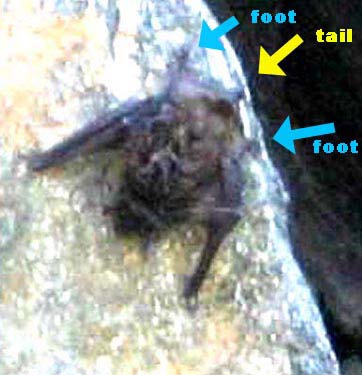 It
is apparent from photos that our 'mystery' bat is not a Western Red nor
Hoary Bat (nor any other large and distinctive bat in California), so it
must be either Big Brown Bat, one of the 7 species of Myotis, or another
small bat. Of the ones fitting our basic shape, Big Brown and 4 species
of Myotis have been recorded at Santa Lucia Preserve (California, Yuma,
Long-legged, Small-footed). Oddly enough, the Anabat survey had Fringe-tailed
at San Clemente but it has not been recorded at adjacent Santa Lucia Preserve.
There are apparently only a few specimens of Little Brown Bat from the
county (none from Santa Lucia). I think we can easily rule out Long-eared
and Small-footed: both have very pale pelage contrasting with black face
and ears, unlike our rather dull, uniform bat. In looking at sketches and
photos, our bat does not have anything close to the long, long ears of
Long-eared, and seems to have too large a size of feet for Small-footed.
I also think the foot size argues against California Myotis, as did the
size of our bat. California Myotis is a quite tiny bat. My feeling was
this was a small bat but not tiny; Big Brown is 30% larger and 50% heavier
than any Myotis or other small bats under consideration, so I think Big
Brown is out (also the feet seem too small compared to photos of Big Brown). It
is apparent from photos that our 'mystery' bat is not a Western Red nor
Hoary Bat (nor any other large and distinctive bat in California), so it
must be either Big Brown Bat, one of the 7 species of Myotis, or another
small bat. Of the ones fitting our basic shape, Big Brown and 4 species
of Myotis have been recorded at Santa Lucia Preserve (California, Yuma,
Long-legged, Small-footed). Oddly enough, the Anabat survey had Fringe-tailed
at San Clemente but it has not been recorded at adjacent Santa Lucia Preserve.
There are apparently only a few specimens of Little Brown Bat from the
county (none from Santa Lucia). I think we can easily rule out Long-eared
and Small-footed: both have very pale pelage contrasting with black face
and ears, unlike our rather dull, uniform bat. In looking at sketches and
photos, our bat does not have anything close to the long, long ears of
Long-eared, and seems to have too large a size of feet for Small-footed.
I also think the foot size argues against California Myotis, as did the
size of our bat. California Myotis is a quite tiny bat. My feeling was
this was a small bat but not tiny; Big Brown is 30% larger and 50% heavier
than any Myotis or other small bats under consideration, so I think Big
Brown is out (also the feet seem too small compared to photos of Big Brown).
This gets us down to four Myotis (Little Brown, Yuma, Long-legged, and Fringed), or maybe another small bat. So I sent the photo to two bat experts: Mark Stromberg at Hastings Reservation in upper Carmel Valley, and Chris Corben, the inventor of Anabat system (and also a bird expert). Both had rather startling replies. Both said that my photos were too poor to identify the bat but both said they could not rule Tadarida — free-tailed bats [Mexican Free-tailed Bat Tadarida brasiliensis). This species has been recorded at both Santa Lucia Preserve and Hastings Reservation, and it is the species that roosts in Carlsbad Caverns, New Mexico, in the millions and is responsible for the famous dusk and dawn "bat flights" there. Chris wrote:
So I think our bat was a Mexican Free-tailed Bat — a common species, perhaps, but one that gave me fits trying to identify. [And I still could be wrong. Chris Corben might lean toward Tadarida but he's not saying it was one.] |
||||
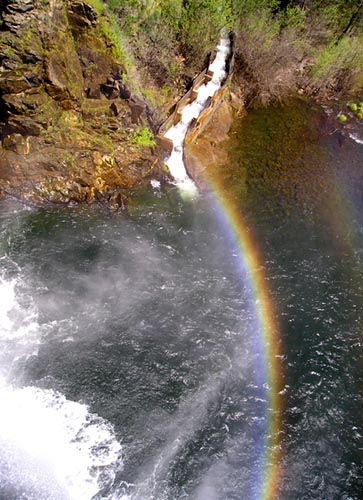 This
final pic (right) is a shot looking down from the dam on a rainbow formed
through the spillway mist. The rainbow ends at the base of the fish ladder.
That fish ladder, we're told, is the tallest fish ladder in North America...
it comes out near the top of the dam after making a switch-back curve. This
final pic (right) is a shot looking down from the dam on a rainbow formed
through the spillway mist. The rainbow ends at the base of the fish ladder.
That fish ladder, we're told, is the tallest fish ladder in North America...
it comes out near the top of the dam after making a switch-back curve.
Here's the result of our VES/AES bird survey of 14 May 2006. Participants were Rita Carratello, Don Roberson, Larry & Carole Rose, Jan Scott, Peter Spillett, Rich & Nancy Trissel, and Brian Weed: Canada Goose 3 pairs
61 species, of which 59 likely nest on or adjacent to Cal-Am property. [Specific breeding evidence noted is listed via Breeding Bird Atlas codes; e.g., FL=Fledgling, CF=Carrying Food, etc.] The exception are Western Tanager — just a May migrant at this elevation — and Common Raven. For the raven, no nesting is known anywhere near this vicinity and it may be a wandering bird. Several of these species were not present here in 1987, including Canada Goose, both Accipiters, and Wood Duck. In May 1987, the following additional species were recorded in the survey area (San Clemente Reservoir to the Filter Plant): All of these were likely breeders, except Double-crested Cormorant. Double-crested Cormorant = does not nest; thought a migrant on 2 May
1987
Together, the May 1987 & May 2006 visits provide evidence of likely nesting of 78 species at San Clemente Reservoir or within 2 miles downstream. Wild Turkey, Barn Owl, and Western Screech-Owl also known from this site from other sources, bringing the local breeding total to 81 species. This does include a few birds that are restricted to oak woodlands surrounding the residential area and filter plant at the entrance (e.g., E. Starling, Bullock's Oriole, House Finch). |
||||
|