These highlights chronicle the year 2026. The year runs generally
"backwards" on this page. In crediting records of vagrant or unusual birds, I always try to credit the finder(s) of the rarity. There will be times when complications arise with credit (e.g., one or more observers find a bird but others are the ones to actually identify it). There are times when a bird is properly identified only days later, and after photo review.
These summaries are not meant to be a "complete" record of birds of interest in MTY in any season — the reports forwarded to the Seasonal Editors of North American Birds magazine are intended to fill that niche — but, rather, these pages are of highlights of a portion of the year that were documented, in most cases, with photos. The abbreviation "MTY" means "Monterey County"
in the text below. Text by Don Roberson. Photos on this page
are copyrighted by the photographers to whom they are
attributed, and may not be reproduced in any form (including
other web sites) without the express consent of the photographer.
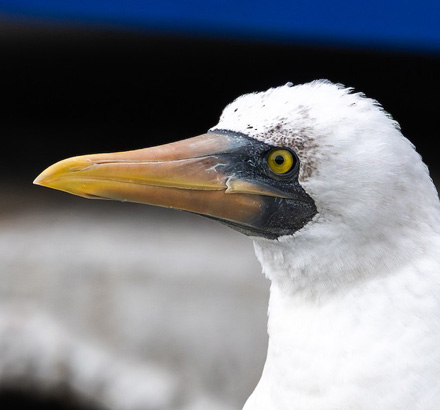
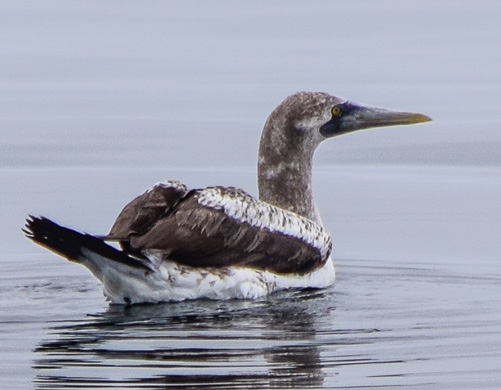
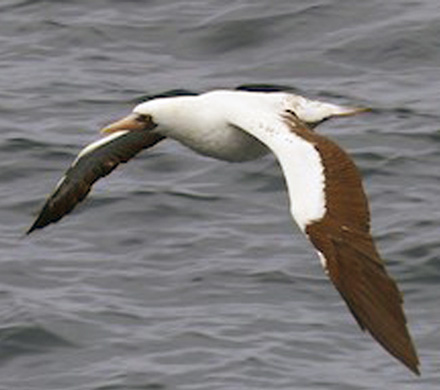
Since late spring, the water temperature off California has been rising, and the predictions suggest that a powerful El Niño is underway. These warm temperatures may inhibit our regularly-nesting seabird colonies as food becomes scarce, but those same warm waters bring equatorial seabirds northward. There are already multiple species of boobies off southern California and, beginning in late April, boobies were again here in the Bay and offshore. Single Cocos Boobies flew past Pt. Pinos on 16 May (Brian L. Sullivan et al.) and 30 July (Catherine Webb). Most impressive has been the number of Nazca Boobies off California this year, including at least five in MTY that were or possibly were Nazca Booby. This species breeds primarily on the Galapagos Islands, so it takes a long flight to get here.
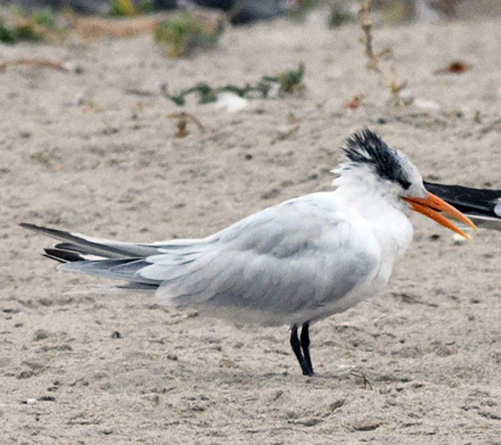
Way back in the early 1900s, 125 years ago, Royal Terns were regular around Monterey Bay, feeding on Pacific Sardine. Overfishing to supply Monterey's "Cannery Row" canning industry was a cause of the collapse of sardine stocks. The canneries closed in the 1940s and Royal Terns became a vagrant locally (see more at Roberson 2002).
Over the last 15 years, several dozen Royals have occurred as late fall and winter vagrants, with only 4 records in spring-summer since 1989. Two in 2022 was a high summer count. Thus, a dozen or so Royal Terns at seven sites suggest that this El Niño may bring back a stronger return of Royal Terns to Monterey Bay.
Monterey Audubon initiated a new conservation project this summer: a Heermann's Gull Monitoring and Conservation effort. Over 90% of the global population breed in the Gulf of California, Mexico, primarily on Rasa Island. However, in 1999, 28 years ago, local birders discovered a tiny breeding colony on two small islets in Roberts Lake, Seaside. From 3 nests on those islets, 8 nestlings successfully fledged in July 1999. This was the first successful breeding of Heermann's Gull in the USA; details at Roberson, Bailey, & Carratello (2001).
The islets in Roberts Lake washed away several years later in winter storms, and the locally breeding Heermann's moved to commercial rooftops. They've had good breeding success some years, and poor success in others. Eventually, some owners of businesses with gulls on their roofs installed netting, making the roofs unavailable to nesting. The hardy avians moved from roof to roof over the years, including to the McDonald's near Roberts Lake, where nesting was succeeding until a car crashed into the McDonald's, starting a fire that destroyed the building and the nests! Many Heermann's moved farther inland to other rooftops, and most now breed on commercial buildings in the Broadway Avenue corridor. Roof-nesting is messy, but Monterey Audubon has reached out to businesses to facilitate clean-up, educate the public on the short breeding season and the need to expect fledglings fallen to a sidewalk or street, and to monitor nesting success. Kai Russell, who's been a leader in this project and has banded some nestlings this year, advises that at least 62 nests were active in 2026, and at least 84 young Heermann's fledged in mid-summer, despite the impending El Niño that may diminish food availability. Population totals for 2026 are not yet tallied, but ad hoc monitoring in 2024 found ~175 adults in the Seaside population. More information and volunteer opportunities appear on the Monterey Audubon website.
An adult Common Ringed Plover, first found and identified on 29 Sep 2025 by Steve Tucker, wintered on the mudflats along Jetty Road, Moss Landing, and adjacent Moss Landing SB at high tide. This is the 4th MTY record, and the second to winter; more in last fall's update. It was well-documented with photos throughout the winter. At least 150 observers from throughout California entered eBird lists, almost all with photos, of this vagrant plover; those viewing without doing eBird lists must double or triple that total. In spring it molted into alternate plumage and lingered to 19 Apr 2026.
Eastern Phoebe is a scarce vagrant to MTY but they average about 1/year, so it has become somewhat "routine" to local birders. This is because about half of them spend the winter here when they do arrive — and birders have months to get around to chase one on the alerts. One in the cemetery by El Estero, City of Monterey, returned for 4 consecutive winters, arriving around Thanksgiving and lingering into March (as late as 28 Mar). Roberson (2002) says that 2-3 other March records might be early spring migrants from wintering not far away to the south. There is only one spring record: 30-31 May 2020 at Hastings NHR (Russell Winter).
This year brought our first April record. On 19 April, Tracy and Greg Plowman stopped for an Eastern Phoebe at the intersection of Carmel Valley Road and Tassajara Road. Efforts to chase it in subsequent days failed. We still lack any record of this phoebe from 1 June to 26 September; 27 Sep 2024 at Pt. Pinos was our earliest fall record.
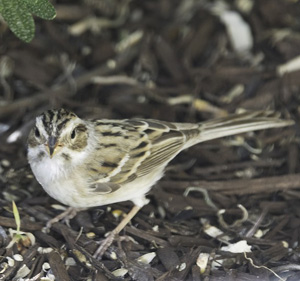
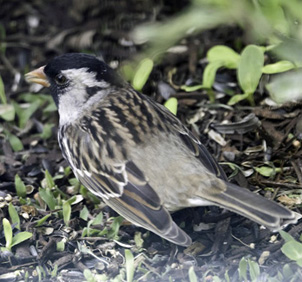
Early winter 2026 was comparatively mild and wet, and some storms later in the season seem to have delayed spring migrants for a few weeks. A number of interesting birds lingered into early spring (including the Hubick family's sparrows, above). Others include:
the Tropical Kingbird present for its 7th consecutive winter was at Laguna Grande Park from 20 Sep 2025 to 7 Apr 2026;
a female Barrow's Goldeneye found off Del Monte Beach, Monterey, in Dec 2025 stayed to 10 January 2026;
a young Painted Bunting at a private yard in Monterey was present 27 Dec 2025 to 10 Jan 2026;
the male Baltimore Oriole that wintered for its second winter in the Hawthorne-Prescott neighborhood left on 15 Feb 2026; the adult female's departure was earlier that same week; and
a young male Summer Tanager in Greenwood Park, Pacific Grove, was there from 17 Jan-11 Apr 2026
Literature cited:
Pyle, P. 2020. Molt, age, and identification of the Masked and Nazca Booby in California. W. Birds 51:129-149.
Roberson, D. 1998. Sulids Unmasked: which large booby reaches California. Field Notes 52: 276-287.
Roberson, D. 2002. Monterey Birds, 2d ed. Monterey Audubon Soc., Carmel, CA.
Roberson, D., S.F. Bailey, and R. Carratello. 2001. First Successful United States Nesting of Heermann's Gull: Challenges of an Urban Colonist. North American Birds 55: 375-378. Available at: https://digitalcommons.usf.edu/nab/vol55/iss3/37
Roberson, D., and C. Tenney, ed. 1993. Atlas of the Breeding Birds of Monterey County, California. Monterey Audubon Soc., Carmel, CA.
I thank Rita Carratello and Bill Hubick for editorial comments on an earlier draft of this page.
 Monterey Audubon initiated a new conservation project this summer: a Heermann's Gull Monitoring and Conservation effort. Over 90% of the global population breed in the Gulf of California, Mexico, primarily on Rasa Island. However, in 1999, 28 years ago, local birders discovered a tiny breeding colony on two small islets in Roberts Lake, Seaside. From 3 nests on those islets, 8 nestlings successfully fledged in July 1999. This was the first successful breeding of Heermann's Gull in the USA; details at
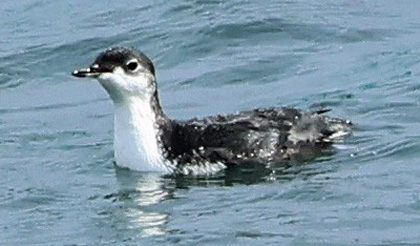
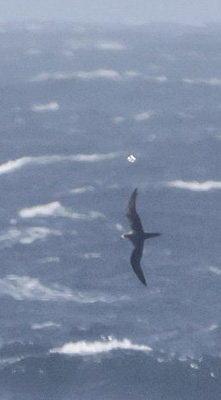 Last year, strong northwest winds at Pt. Pinos in mid-May 2025 permitted sea-watchers at Pt. Pinos to spot 8-10 Hawaiian Petrels from shore. This year, strong northwest winds began earlier and continued throughout May. Again, Hawaiian Petrels were seen from shore, at least 7 over 6 days, with the earliest on 30 April (photo right, 30 Apr, © Kyan Russell). In addition, there were at least seven Manx Shearwater in May, and single Horned Puffin were spotted from the Point on 31 May (Kyan Russell) and 6 June (Catherine Webb, B.L. Sullivan et al.)
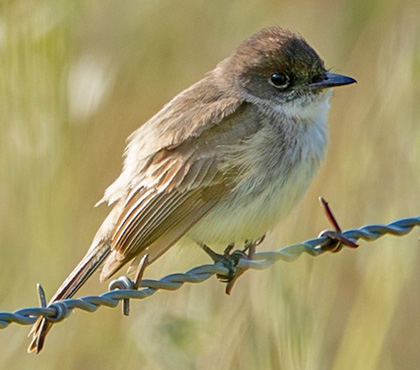 Eastern Phoebe is a scarce vagrant to MTY but they average about 1/year, so it has become somewhat "routine" to local birders. This is because about half of them spend the winter here when they do arrive — and birders have months to get around to chase one on the alerts. One in the cemetery by El Estero, City of Monterey, returned for 4 consecutive winters, arriving around Thanksgiving and lingering into March (as late as 28 Mar). Roberson (2002) says that 2-3 other March records might be early spring migrants from wintering not far away to the south. There is only one spring record: 30-31 May 2020 at Hastings NHR (Russell Winter).