| |
BABBLERS Timaliidae
|
- 259 species in Old World (excluding Australasia), mostly in the tropics
- DR personal total: 83 species (32%), 18 photo'd
|
In
the Old World tropics live hundreds of elusive small to mid-sized birds
— babblers! Often first located by sound, many species are elusive in
the shadows and undergrowth, even where they are common. Just one
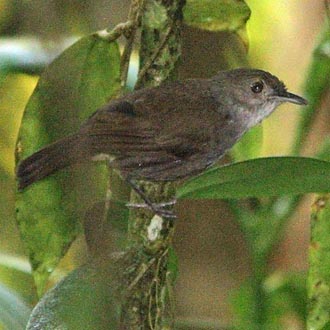
example is the only babbler to cross Wallace's Line, the Sulawesi Babbler (left).
Babblers were once considered a huge family of over 300 species. Studies in the
mid-2000s began to clarify the situation (e.g., Cibois 2003,
Alström et al. 2006, Jønsson & Fjeldså 2006) but
there is uncertainty whether the huge babbler assemblage should be
allocated to one or two or more families. Genetic evidence revealed that the Sylvia warblers — the original genus in the 'Old World Warblers'
Sylviidae — were more closely related to Babblers than other Old World
Warblers [see a discussion of the break-up of the Old World Warblers].
Additional research, especially Gelang et al. (2009), led to a
"break-up of the Babblers." Cibois et al. (2010) summarized the
outlines for five babbler families: tree babblers and scimitar-babblers
[Timaliidae], sylvid babblers and parrotbills [Sylviidae], white-eyes
[Zosteropidae], fulvettas and ground-babblers [Pellorneidae], and
laughingthrushes [Leiothrichidae]. This concept was initially accepted
here in my Family pages, with the proviso that the "five-family
solution remains tentative and subject to future research."
More
recently, Moyle et al. (2012) confirmed the major clades in the babbler
assemblage, but recommended that the tree-babblers, laughingthrushes,
and the ground-babblers, be considered subfamilies of
an expanded Babbler family [Timaliidae]. One of the reasons has to do
with the amount of evolutionary time with the other related Families
remaining the Sylvids and the White-eyes. I now follow that approach.
The
core babblers split from the White-eyes and relatives in the early
Miocene, estimated at 16–21 million years ago (mya; Moyle et al.,
2012). Although that is a long time ago, it is not nearly as old as,
for example, the Family level groups in the broadbill assemblage
[African & Green Broadbills, Asian & Grauer's Broadbills,
Asities, and Sapayoa in the New World] that diverged 45–56 mya (Moyle
et al. 2006). So a Family level at perhaps 20 mya or has not been on
its own evolutionary path as long as many bird families. My feeling is
that something that diverged in early Miocene (about 16-23 mya) is a
good guideline for a minimum of age of what we call a Family. Younger
divergence might better be considered subfamilies. The three main
clades of the core babblers — the tree-babblers &
scimitar-babblers, the laughingthrushes, and the ground-babblers —
began diverging 11.2–17.8 mya (Moyle et al. 2012). The main African
radiations among babblers are even younger: the origin of the Illadopsis babblers is 10-14 mya, and the radiation of Turdoides babblers to Africa is 6.4-9.9 mya. These latter divergence times recall those of the ancestor of today's Wrentit Chamaea fasciata of western North America, which began diverging from its parrotbill ancestors about 6.5-8.1 mya (Burns & Barhoum 2006).
This
puts some perspective on the scale of evolution. Families should be, in
my opinion, the most distinctive and long-evolved of monophyletic
groups. I agree with Moyle et al. (2012) that the three major clades of
babblers are best considered subfamilies, and I now treat that this
way. A page on each subfamily is now provided: use the links or photos below to reach them: |
| |
| What
this all means is that again we have a very large Babbler family. It is
not as many species as it once was (see below) but at over 250 species,
it still has many birds among its three subfamilies. It should also be
stated that this "three subfamily" approach to "one big Babbler family"
is not that of every taxonomist. Not long after Moyle et al. (2012)
published their molecular findings and expressed the preference to
place the three main clades of babblers as subfamilies, Fregin et al.
(2012) published their molecular findings and expressed not only a
preference for retaining all three babbler clades as separate families,
but went on to formally describe new Families in the Cettiidae
assemblage, thus creating new Families for groups no one had ever
suggested warranted that level of distinctiveness (e.g., Fregin et al.
2012 named the Scotocercidae for the monotypic Scrub Warbler Scotocerca inquieta
of north Africa and the Middle East). The genetic evidence is the same
but the approach to the concept of what is a Family is different. In
reviewing these different philosophies, I prefer the more conservative
Moyle et al. (2012) approach, which limits Family level groups to the
most ancient and distinctive, and using Subfamilies for younger clades.
|
|
Whatever
your preference as to what constitutes a bird Family, all the recent
research has combined to give us a much better appreciation of the
relationships of many birds. It is especially interesting to understand
what is not a babbler:
For example, Gelang
et al. (2009) found that one of a half-dozen
genera of wren-babblers — the four species in genus Pnoepygidae — were not within any babbler lineage. They recommended a new family,
the Pnoepygidae, for those tiny, short-tailed, "wren-babblers", which are now known as Cupwings. The
remaining genera of birds termed wren-babblers (e.g., Rimator, Ptiolcichla, Kenopia, Napothera, Spelaeornis) are babblers but are assigned to various babbler subfamilies. Moyle et al. (2012) found that three aberrant "babblers" in the Philippines — Leonardina, Robsonius, and Micromacronus (the two "miniature-babblers") — plus the endemic genus Malia of Sulawesi — were not babblers at all. Where these enigmas may be placed will be the subject of upcoming papers.
Beyond these, earlier dramatic findings included:
- White-bellied "Yuhina" is actually a relict vireo living in Asia. It now goes by the name Erpornis Erpornis zantholeuca (Cibois 2003). Shrike-babblers in genus Pteruthius
are also related vireos (Reddy & Cracraft 2007) but diverged a long
time ago, and I tentatively considered them to form their own family.
- Although
traditionally considered babblers, rockfowl, rockjumpers, and
rockrunners of Africa are not babblers; the first two are now assigned
their own families near the base of the passerine tree, while
rockrunner appears to be in a new "African warbler" lineage that is
also a new family.
- Rail-babbler of tropical
southeast Asia is not a babbler, but is most closely related to
rockjumpers, and is best assigned its own family.
- All the birds named "babblers" in Madagascar, or traditionally listed as babblers in Malagasy field guides, are not babblers.
- Gray-chested "Illadopsis" Kakamega poliothorax, whose generic name commemorates the Kakamega Forest of w. Kenya, is not a babbler but is, along with Spot-throat Modulatrix stictigula and Dapple-throat Arcanator orostruthus, now tentatively placed with the sugarbirds in the Promeropidae.
And yet beyond all this, many traditional babbler genera have proved to be paraphyletic (e.g., Stachyris
is now split into 4 genera; Moyle et al. 2012). Thus the entire Babbler
"apple-cart" has been turned over, sorted out, and reassigned as the
evolutionary relationships have been sorted out. It is still a very
large group of Asian and African birds, but today's Babbler family
bears only partial resemblance to the 'traditional' babblers of yore. |
|
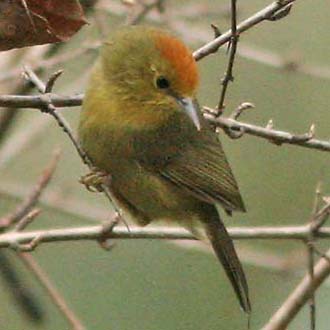
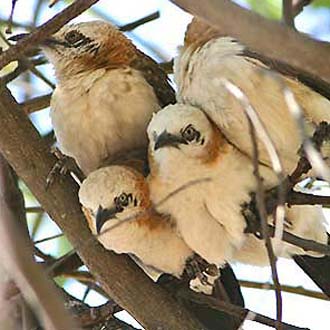
| Photos: The two shots of Sulawesi Babbler Pellorneum celebense are from Gunung Ambag, Sulawesi, on 5 Oct 2011. The Rufous-capped Babbler Cyanoderma ruficeps was photographed in Foping Nature Reserve, Shaanxi, China, on 13 Nov 2010. The huddled group of Bare-cheeked Babbler Turdoides gymnogenys was at Etosha NP, Namibia, in July 2005. All
photos © Don Roberson; all rights reserved. |
Bibliographic notes
There
is no recent "family book" covering the Babblers but excellent coverage
is in Collar & Robson (2007). The account is wonderful, with
exceptional
photos, although it is not quite up to speed with the most current
taxonomic findings.
Literature cited:
Alström
P., P.G.P. Ericson, U. Olsson, and P. Sundberg. 2006. Phylogeny and
classification of the avian superfamily Sylvioidea. Molecular
Phylogenetics & Evolution 38: 381-397.
Barker,
F.K., A. Cibois, P. Schikler, J. Feinstein, and J. Cracraft. 2004.
Phylogeny and diversification of the largest avian radiation. Proc.
Nat. Acad. Sci. 101: 11040-11045.
Burns, K.J., and D.N. Barhoum. 2006. Population-level history of the wrentit (Chamaea fasciata): implications for comparative phylogeography in the California Floristic Province. Molec. Phylog. Evol. 38: 117-129.
Cibois, A. 2003. Mitochondrial DNA phylogeny
of babblers (Timaliidae). Auk 120: 35-54.
Cibois,
A., E. Pasquet, and T.S. Schulenberg. 1999. Molecular systematics of
the Malagasy babblers (Timaliidae) and Warblers (Sylviidae), based on
cytochrome b and 16S rRNA sequences. Molec. Phylog. Evol. 3: 581-595.
Cibois,
A., M. Gelang, and E. Pasquet. 2010. An overview of the babblers and
associated groups. Systematic Notes on Asian Birds 68: 1-5.
Cibois,
A., B. Slikas, T.S. Schulenberg, and E. Pasquet. 2001. An endemic
radiation of Malagasy songbirds is revealed by mitochondrial DNA
sequence data. Evolution 55: 1198-1206.
Cibois, A. 2003. Mitochondrial DNA phylogeny of babblers (Timaliidae) Auk 120: 35-54.
Collar,
N.J., M.J. Crosby, and A. J. Stattersfield. 1994. Birds to Watch 2: The
World List of Threatened Birds. Birdlife Conserv. Ser. 4. Birdlife
Intern'l, Smithsonian Inst., Washington, D.C.
Collar, N.J., and C. Robson. 2007. "Babblers (Timaliidae)," pp. 70-291 in
Handbook of the Birds of the World (del Hoyo, J., A. Elliott & D.A.
Christie, eds). Vol. 12. Lynx Edicions, Barcelona, Spain.
Fregin,
S., M. Haase, P. Alström, and U. Olsson. 2012. New insights into
family relationships within the avian superfamily Sylvioidea
(Passeriformes) based on seven molecular markers, BMC Evol. Biol. 12:
157
Gelang,
M., A. Cibois, E. Pasquet, U. Olsson, P. Alström, and P.G.P.
Ericson. 2009. Phylogeny of babblers (Aves, Passeriformes): major
lineages, family limits and classification. Zoologica Scripta 38:
225-236.
Jønsson,
K.A., and J. Fjeldså. 2006. A phylogenetic supertree of oscine
passerine birds. Zoologica Scripta 35: 149-186.
Moyle,
R.G., R.T. Chesser, R.O. Prum, P. Schikler, and J. Cracraft. 2006.
Phylogeny and evolutionary history of Old World suboscine birds (Aves:
Eurylaimides). Amer. Mus. Novitates 3544: 1-22
Moyle,
R.G., M.J. Andersen, C.H. Oliveros, F.D. Steinheimer, and S. Reddy.
2012. Phylogeny and biogeography of the core Babblers (Aves:
Timaliidae). Syst. Biol. 61: 631-651.
Reddy, S., and J. Cracraft. 2007. Old World Shrike-babblers (Pteruthius) belong with New World Vireos (Vireonidae). Molec. Phylog. Evol. 44: 1352-1357.
Sibley,
C. G., and J. E. Ahlquist. 1990. Phylogeny and Classification of Birds:
A Study in Molecular Evolution. Yale Univ. Press, New Haven, CT.
Sibley, C. G., and B. L. Monroe. 1990. Distribution and Taxonomy of Birds of the World. Yale Univ. Press, New Haven, CT.
|
|
|